
 Amit Kalley
Children are online more than ever before. Ofcom’s Children and Parents: Media Use and Attitudes Report (2024) found that 97% of children aged 3–17 went online last year, with nearly half of 8–17-year-olds owning their own smartphone. But many parents don’t know what apps their children are using, or the dangers these platforms can pose.
Not knowing can be catastrophic. From grooming and scams to exposure to adult content, ignoring the risks isn’t an option.
Below, we explore the six key categories of apps parents need to be aware of, why they may be risky, and how to have conversations that protect children.
🎮 Gaming & Virtual Worlds
Examples: Roblox, Fortnite, Minecraft, AmongUs
These games are hugely popular but come with risks:
- Chat features allow contact with strangers, raising risks of grooming.
- Scams and in-game purchases can target children’s vulnerability.
- Adult content and inappropriate behaviour can sometimes slip through moderation.
Studies show that online multiplayer games can increase children’s exposure to predatory behaviour. For example, Whittle et al. (2017) in the Journal of Sexual Aggression identified grooming in virtual environments as a growing concern.
📱 Social Media
Examples: TikTok, Snapchat, Instagram, BeReal
Algorithms are designed to maximise attention, not safety. Children can be:
- Exposed to harmful content (extreme diets, violence, self-harm).
- Bullied via direct messages (DMs).
- Targeted by strangers pretending to be peers.
A 2023 report from the UK Centre for Mental Health linked heavy social media use with increased risk of anxiety and depression in adolescents.
❤️ Dating Apps
Examples: Tinder, Bumble, POF, Tagged
Though designed for adults, children can access these apps by lying about their age. This creates serious risks:
- Predatory contact
- Exploitation through sexual messaging
- Exposure to adult images and behaviours
The NSPCC highlights that children under 18 using dating apps are at heightened risk of sexual exploitation, with reported cases where predators deliberately target underage users.
🙈 Anonymous & Hidden Messaging
Examples: Yubo, Wizz, NGL, “Vault” apps disguised as calculators
The appeal of these apps is secrecy. For children, this can mean:
- Bullying hidden from adults
- Sextortion and coercion
- Unsafe sharing of personal or sexual images
Patchin & Hinduja (2020) found that anonymity online significantly increases the likelihood of cyberbullying behaviours.
🎥 Livestreaming
Examples: Twitch, Discord, Kick, BIGO LIVE
Livestreaming makes children performers in front of often-unfiltered audiences. Risks include:
- Inappropriate comments in real time
- Pressure to behave in ways that attract attention
- Lack of control once content is broadcast
A 2021 EU Kids Online study highlighted livestreaming as one of the highest-risk online activities for grooming.
🤖 AI Chatbots & Companions
Examples: Character.AI, Replika, ChatGPT
These AI “friends” can feel safe and comforting, but they also:
- Simulate intimacy and friendship, blurring lines between reality and fiction
- Expose children to sexualised or harmful conversations
- Provide unsafe advice with no accountability
Research from the Oxford Internet Institute (2023) raised concerns about children’s reliance on AI companions, noting risks around mental health and inappropriate interactions.
What Parents Can Do
- Stay informed – Know what apps are popular and how they work.
- Talk openly – Ask children what apps they use and why. Make it safe for them to share.
- Set boundaries – Use parental controls, but combine them with trust and discussion.
- Model healthy behaviour – Show your own balanced relationship with technology.
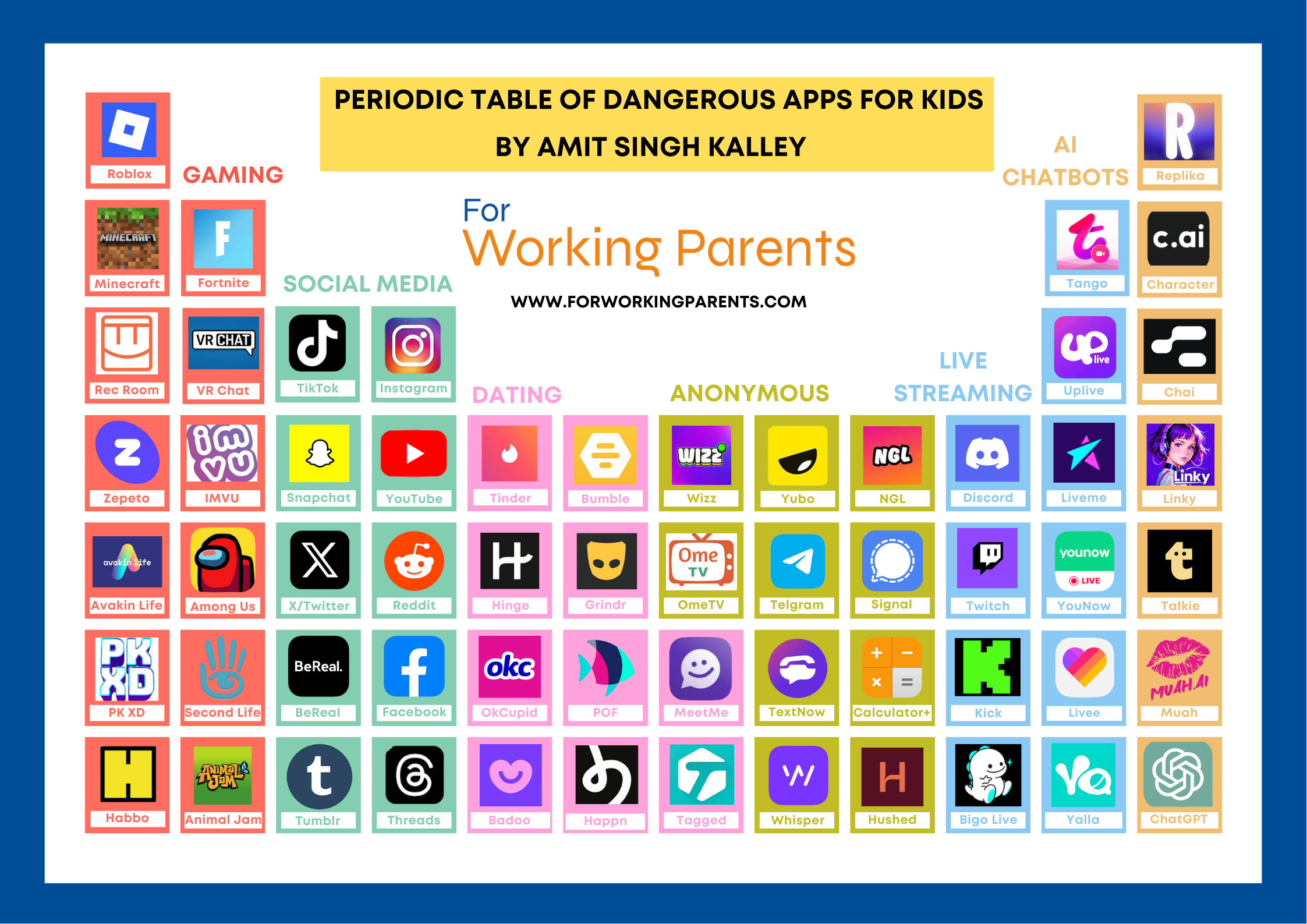
A Tool for Parents: The Periodic Table of Apps
To make it easier, I’ve created a Periodic Table of Apps highlighting platforms that can be dangerous for children. Like my earlier “Periodic Table of Sinister Emojis,” it’s designed to help parents quickly spot risks and start conversations.
Not every app is “bad.” But every app has the potential to be unsafe if children use it without guidance. The best defence is informed, proactive parents who stay one step ahead.